


-
About UsYongbang dry spirit of enterprise is "practical work, humility, peaceful competition, development and development". It is under the inspiration of this spirit that we have embarked on the road of establishing and building Yongbang enterprises. Yongbang Dry and Yongbang Intelligence are a group of young intellectuals. We follow the behavior principle of "peaceful competition, development and development". To be the master of modern economy and the standard bearer of new energy equipment.

-
Products
-
-
-
News Center

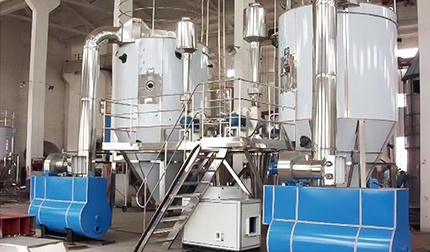

Papua New Guinea PLG series disc continuous dryer
Product Description
Overview
The disc continuous dryer is an efficient conductive continuous drying equipment. Its unique structure and working principle determine that it has the characteristics of high thermal efficiency, low energy consumption, small footprint, simple configuration, convenient operation and control, and good operating environment; it is widely used in new energy materials, chemicals, medicine, pesticides, food, Drying operations in feed, agricultural and sideline products processing and other industries. For materials such as lithium chloride, lithium carbonate, lithium hydroxide, nickel hydroxide, cobalt carbonate and ternary materials from centrifuges or filter presses, the disc dryer developed by our company is a multi-layer fixed hollow heating circular loading disc, rake stirring and vertical continuous heat conduction-based drying equipment based on intermittent stirring conduction dryer and a series of advanced technologies. Because the heat required for drying the equipment relies on indirect heat transfer by heat conduction, the drying process does not need or only a small amount of gas to take away moisture. It greatly reduces the heat loss of this part of the gas, improves the heat utilization rate, and is an energy-saving drying equipment.
Structural features
The rake frame of the special disc dryer for battery materials is made of (304/316L/titanium material to choose from); The rake sheet is made of tetrafluoro rake sheet or other special plastic rake sheet, and the disc surface is mirror polished (Ra≤ 0.4) to minimize the friction between tetrafluoro rake sheet or other special plastic rake sheet and the surface of the mirror disc.
Disc dryer rake arm in the production process often occurs bending deformation, in view of this phenomenon our company specially to improve, the use of thick-walled steel pipe, pipe insert round steel to strengthen, so that the harrow arm of the load-bearing force to strengthen, so as to avoid the phenomenon of bending deformation.
In order to ensure the flatness of the heating plate surface, the outer retaining ring of the large plate surface and the inner blanking ring of the small plate surface are all formed by one-time drum pressing of the steel plate. The upper pressing of the outer edge of the large plate is circular arc, and the lower pressing of the small plate surface is circular arc, so that the hardness of the plate surface is greatly strengthened and smoother at the same time.
Many battery materials have a lot of residue and scarring on the drying tray. The original pressing scraper is easy to accumulate materials along the horizontal edge, the knife surface is directly bent, and the weight of the scraper is too light, resulting in a lot of material residue on the tray surface, especially the material with high density is more difficult to scrape. Our company adopts a special structure for the design of the rake rod and rake leaves of the disc dryer to prevent the rake leaves from upwarping due to the scarring of the drying disc, thus solving the problem of disc area material.
After some wet materials enter the disc dryer, if the wet parts cannot be quickly dispersed in the first few layers, it is easy to produce agglomeration. Our company designs to set a certain number of pressure rollers on the heating plate with the middle and upper layers, which can crush the caked materials in time and ensure the dispersion and fluidity of the materials in the drying process.
Change the way of heat source in and out of the traditional disc dryer to avoid short circuit of heat source in the disc and uneven heating of materials on the disc surface. Our company is designed for double (multi) in and double (multi) out, so that the heat source is distributed more evenly in and out, the disk surface material absorbs heat more fully, and the thermal efficiency is greatly improved.
The material is very easy to fall into the bottom layer during the landing process, and uneven drying will cause fine powder to penetrate into the bearing. Our company has made special improvements to this situation, adding a hoop-shaped cone-shaped pagoda seat in the middle of each layer of material tray, so that the material on the upper plate surface can smoothly slide along the cone into the lower plate surface when falling, thus avoiding the phenomenon that the lower plate surface falls into the bottom layer when the material falls, and the hoop-shaped design is also conducive to maintenance. Bearing protection using the labyrinth and packing double seal, to prevent the occurrence of micro-powder damage to the bearing.
Our company will add a baffle plate inside each heating plate to make the heat-conducting medium flow fully in the plate to prevent short circuit and generate large temperature difference locally, thus ensuring the average temperature of the plate surface.
The material of the rotary valve body is titanium, and the rotary blade is nylon, so as to avoid the phenomenon that the magnetic foreign body increases due to the metal friction between the ordinary rotary valve blade and the shell.
Working principle
Wet materials are continuously added to the drying tray of the first layer on the upper part of the dryer from the feeder, and the rake arm with rake leaves rotates to make the rake leaves continuously copy the materials. The material flows through the surface of the drying tray along the exponential spiral line. The material on the small drying tray is transferred to the outer edge and falls to the outer edge of the lower large drying tray at the outer edge. The material moves inward on the large drying tray and falls into the next layer of small drying tray from the middle blanking port. The size of the drying plate is arranged alternately up and down, and the material can flow continuously through the whole dryer. Hollow drying plate into the heating medium, heating medium in the form of saturated steam, hot water and heat transfer oil, heating medium from one end of the drying plate into, from the other end of the export. The dried material falls from the last layer of drying tray to the bottom layer of the shell, and is finally transferred to the discharge port by the rake blade for discharge. The wet part overflows from the material and is discharged from the wet discharge port on the top cover, and the moisture of the vacuum type disc dryer is pumped out by the vacuum pump port on the top cover. The dry material discharged from the bottom layer can be directly packaged. Through the auxiliary machines such as fin heater, solvent recovery condenser, bag filter, dry material mixing mechanism, induced draft fan, etc., the drying production capacity can be improved, the paste paste and heat sensitive materials can be dried, the solvent can be easily recovered, and the pyrolysis and reaction operation can be carried out.

Technical characteristics
(I) drying tray
★Design pressure: generally 0.4MPa, up to 1.6MPa.
★Heating medium: heat with hot water when it is less than 100 ℃, heat with steam when it is 100 ℃ ~ 150 ℃, and heat with heat transfer oil when it is 150 ℃ ~ 320 ℃.
(II) material conveying system
★Spindle speed: 1~10 r/min, electromagnetic or variable frequency stepless speed regulation.
★Rake arm: there are 4~8 rake arms fixed on the main shaft on each layer of drying tray.
★Rake blade: hinged on the arm, can float up and down with the disk to maintain contact, there are many forms.
★Milling roller: for materials that are easy to agglomerate and need to be crushed, adding grinding rollers at appropriate positions can strengthen the heat transfer and drying process.
The (III) shell has three types: atmospheric pressure, airtight and vacuum
★Atmospheric pressure type: there are two kinds of structure, integral and split. The main pipe for the inlet and outlet of the heating medium can be inside the shell or outside the shell.
★Closed type: cylindrical shell, can withstand 5Kpa internal pressure, heating medium import and export main pipe can be in the shell, can also be outside the shell.
★Vacuum type: cylindrical shell, the design pressure is -0.1Mpa, the main pipe of heating medium import and export is in the shell.
(IV) air heater
★It is generally used in the case of large evaporation to enhance drying efficiency
Application
(I) battery materials: cobalt oxide, lithium carbonate, lithium hydroxide, nickel hydroxide, cobalt carbonate and ternary precursors, cathode materials, sodium electric materials, etc.
(II) other chemical products, medicine, food, feed, fertilizer, etc.

Technical parameters
| Specifications | Outer diameter mm | Height mm | Drying area ㎡ | Power Kw |
| 1200/4 | Φ1850 | 2718 | 3.3 | 1 |
| 1200/6 | 3138 | 4.9 | ||
| 1200/8 | 3558 | 6.6 | 1.5 | |
| 1200/10 | 3978 | 8.2 | ||
| 1200/12 | 4398 | 9.9 | 2.2 | |
| 1500/6 | Φ2100 | 3022 | 8.0 | |
| 1500/8 | 3442 | 10.7 | ||
| 1500/10 | 3862 | 13.4 | ||
| 1500/12 | 4282 | 16.1 | ||
| 1500/14 | 4702 | 18.8 | 3.0 | |
| 1500/16 | 5122 | 21.5 | ||
| 2200/6 | Φ2900 | 3319 | 18.5 | |
| 2200/8 | 3739 | 24.6 | ||
| 2200/10 | 4159 | 30.8 | 4.0 | |
| 2200/12 | 4579 | 36.9 | ||
| 2200/14 | 4999 | 43.1 | 5.5 | |
| 2200/16 | 5419 | 19.3 | ||
| 2200/18 | 5839 | 55.4 | 7.5 | |
| 2200/20 | 6259 | 61.6 | ||
| 2200/22 | 6679 | 67.7 | 11 | |
| 2200/24 | 7099 | 73.9 | ||
| 2200/26 | 7519 | 80.0 | ||
| 2500/6 | Φ3150 | 3319 | 26.3 | 4 |
| 2500/8 | 3739 | 35 | ||
| 2500/10 | 4159 | 43.8 | 5.5 | |
| 2500/12 | 4579 | 52.5 | ||
| 2500/14 | 4999 | 61.3 | 7.5 | |
| 2500/16 | 5419 | 70 | ||
| 2500/18 | 5839 | 78.8 | 11 | |
| 2500/20 | 6259 | 87.5 | ||
| 2500/22 | 6679 | 96.3 | ||
| 2500/24 | 7099 | 105 | 13 | |
| 2500/26 | 7519 | 113.8 | ||
| 3000/8 | Φ3800 | 4050 | 48 | 11 |
| 3000/10 | 4650 | 60 | ||
| 3000/12 | 5250 | 72 | ||
| 3000/14 | 5850 | 84 | ||
| 3000/16 | 6450 | 96 | ||
| 3000/18 | 7050 | 108 | 13 | |
| 3000/20 | 7650 | 120 | ||
| 3000/22 | 8250 | 132 | ||
| 3000/24 | 8850 | 144 | ||
| 3000/26 | 9450 | 156 | 15 | |
| 3000/28 | 10050 | 168 |
Service Hotline
Address: No. 28, Park Road, Bieqiao Town, Liyang City, Changzhou City, Jiangsu Province, China
E-mail: yongbang@jsybzn.cn

WeChat public number
Get more services

Copyright©2024 Jiangsu Everland Intelligent Equipment Technology Co., Ltd. www.300.cn | SEO